


Cover image by Tobii
Table of Contents:
- Introduction
- Why Eye Tracking Is Transformative for E-Commerce Research
- Applications of Eye Tracking in E-Commerce
- Case Example: Eye Tracking for Product Listing Pages
- Conclusion
Introduction
E-commerce environments are visually dense, decision-heavy, and highly competitive. In this landscape, understanding how consumers interact with digital storefronts is just as important as understanding what they click or purchase. Eye tracking offers precise insights into shoppers’ attention patterns, revealing how they perceive products, navigate interfaces, and make purchase decisions.
Unlike traditional analytics, which focus on observable behaviour (clicks, conversions, scroll depth), eye tracking uncovers the cognitive and perceptual mechanisms underlying those behaviours. By mapping where consumers look, how long they dwell, and how their gaze moves across pages, brands can refine product presentation, pricing strategies, recommendation systems, and checkout flows, ultimately improving conversion rates and customer satisfaction.
Online shopping is driven by attention. Every product card, banner, price point, and filter competes for the shopper’s finite cognitive bandwidth. In this attention economy, small design choices, such as image order, font size, or label placement can dramatically influence behaviour.
Traditional UX and analytics tools reveal what consumers do on an e-commerce website, but not how they visually process the marketplace. Eye tracking bridges that gap, helping retailers understand:
- Which products draw immediate attention
- Whether promotional banners are actually seen
- How shoppers evaluate product lists or search results
- What causes hesitation or abandonment
- How layout and visual hierarchy influence decision-making
These insights enable evidence-driven optimisation of product discovery and purchase pathways.
Why Eye Tracking Is Transformative for E-Commerce Research
1. Understanding Pre-Decision Behaviour
A shopper may click one item but spend longer looking at another. Eye tracking uncovers these hidden preferences, helping companies understand interest levels that behavioural data alone cannot reveal.
2. Visual Hierarchy Drives Sales
Product images, ratings, price tags, delivery information, and discounts guide the consumer’s assessment. Eye tracking identifies whether this hierarchy is intuitive or if crucial details are being overlooked.
3. Identifying Cognitive Load and Choice Overload
Large product assortments can overwhelm shoppers. Eye-movement patterns, pupil dilation, and gaze dispersion indicate moments when consumers are struggling, allowing brands to simplify or personalise experiences to reduce cognitive fatigue.
4. Measuring Trust Cues
In online shopping, trust is built visually: reviews, star ratings, return policies, secure payment badges. Eye tracking reveals whether consumers notice these cues and how they influence decision-making.

Image by Adrienne Cardy from Explore Research
Applications of Eye Tracking in E-Commerce
1. Product Discovery & Search Optimization
Eye tracking reveals:
⇒Whether filters and sorting tools are noticed
⇒How users scan product lists
⇒Which product thumbnails attract attention
⇒Whether sponsored products disrupt scanning flow
⇒These insights guide optimisation of search results, carousels, and recommendation algorithms.
2. Product Page Evaluation
A product detail page must build trust quickly. Eye tracking can determine:
⇒Whether users see essential elements (images, price, delivery date, reviews)
⇒The relative impact of lifestyle vs. studio photos
⇒How long shoppers spend examining specifications
⇒Whether similar items distract attention
This helps in crafting PDPs that inform rather than overwhelm.
3. Pricing & Discount Perception
Consumers react strongly to price cues. Eye tracking shows:
⇒Whether discounts stand out
⇒How shoppers compare price and value
⇒Whether complex pricing structures (e.g., EMI, bundles) cause confusion
Retailers can then design clearer, more persuasive pricing displays.
4. Trust, Reviews, and Social Proof
Eye tracking identifies how consumers assess credibility:
⇒Do they look at reviews early or after reading product details?
⇒Are star ratings more attention-grabbing than textual reviews?
⇒Are trust badges and return policies visible enough?
This helps brands present trust signals strategically.
5. Checkout and Conversion Flow
One of the highest-impact use cases:
⇒Are errors or instructions noticed in real time?
⇒Do visual distractions delay checkout completion?
⇒Is the payment CTA visible and clear?
Eye tracking exposes micro-frictions that analytics cannot detect.
6. A/B Testing with Visual Evidence
Eye tracking enhances A/B testing by offering perceptual data. Instead of only comparing conversions, teams can compare:
⇒Attention distribution
⇒Gaze order
⇒Dwell time on critical elements
⇒Impact of layout or image changes
This leads to more precise design decisions.
Case Example: Eye Tracking for Product Listing Pages
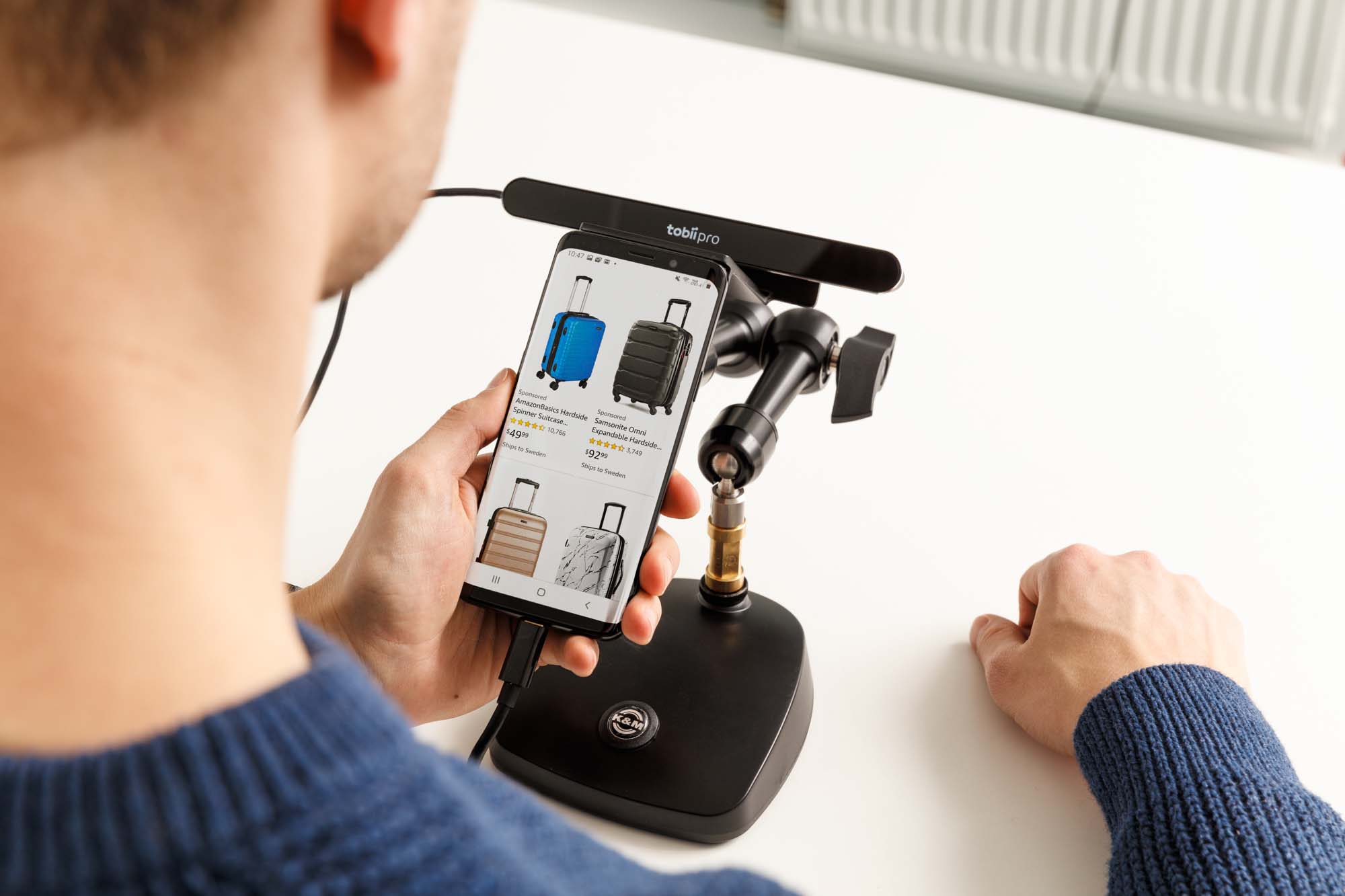
Image by Tobii
Objective: Improve discovery and click-through on a fashion retailer’s product listing page (PLP).
Findings:
⇒Shoppers consistently fixated on models wearing full outfits, skipping items shown on hangers.
⇒Discount labels were seen too late, reducing promotional impact.
⇒Eye movements zig-zagged, indicating inefficient scanning caused by misaligned image grids.
⇒High-rated products drew attention only when stars were placed near the top-left corner.
Actions Taken:
⇒Introduced more lifestyle photography
⇒Standardised grid layout
⇒Moved discount labels and review stars to high-visibility zones
⇒Added colour swatches directly under images
Outcome:
Higher click-through rates, reduced time-to-product-selection, and improved satisfaction.
Strategic Benefits for E-Commerce Brands
- Higher conversions through optimised visual pathways.
- Reduced cognitive load leading to faster decisions and lower bounce rates.
- Enhanced product presentation based on real attention patterns.
- Improved trust perception via strategically placed credibility cues.
- More effective merchandising and promotions.
- Insight-driven personalisation – recommendation engines improve when grounded in visual preferences.
Eye tracking transforms intuition-driven design into evidence-driven optimisation.
Conclusion:
Eye tracking offers unparalleled insights into how consumers see, process, and evaluate e-commerce interfaces. By illuminating the hidden layers of consumer attention and decision-making, it empowers brands to refine everything from product discovery to final checkout. In an increasingly competitive digital marketplace, understanding visual behaviour is not a luxury, it is a strategic necessity. E-commerce companies that leverage eye tracking gain a powerful advantage: the ability to design experiences that are intuitive, persuasive, and built around the real behaviour of real shoppers.
If you’d like to dive deeper into any particular study or point, feel free to ask us at parag@tidentech.com or tidentech@gmail.com or call us on +91 9987442274.